
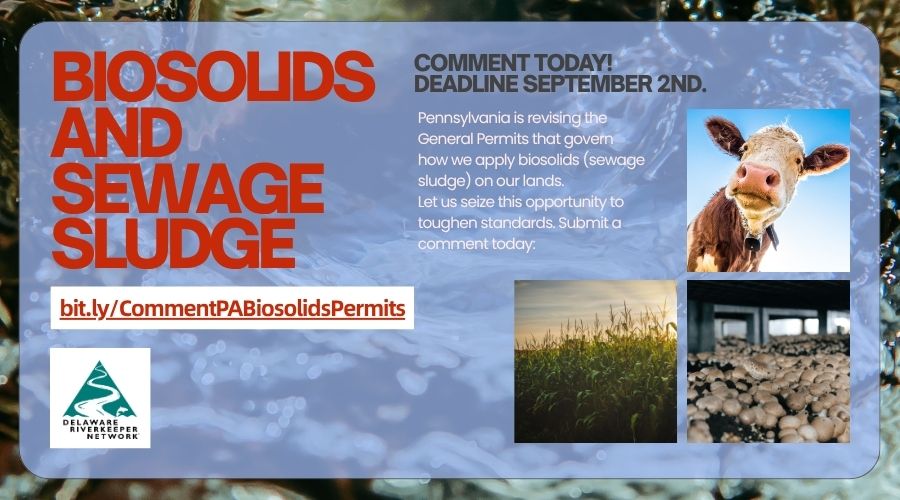
Deadline: Sunday September, 2nd.
Tell them to toughen permit requirements for the land application of biosolids!
The Department of Environmental Protection (PADEP) is proposing revisions to the General Permits that cover biosolids/sewage sludge and how we apply them on land. We need many people and organizations from throughout PA to submit written comments to DEP and to demand public hearings be added to expand public input.
Delaware Riverkeeper Network has suggested points in a sample comment that we are offering for your consideration and also background information with references to published reports and studies that you can use to craft a more extensive comment. PADEP is proposing to make changes to 4 topics in the 3 General Permits for the land application of sewage sludge/biosolids. The proposed revisions move us towards limiting the release of dangerous pollutants and the resulting harmful health and environmental impacts, but they do not go far enough – PA can do better, let’s tell them how.
- Sewage sludge, processed into “biosolids”, is allowed to be applied on land in PA but data shows pollution is occurring as a result.
- The runoff and leachate from biosolids can contaminate groundwater, surface water, soil, air, and crops/farm products.
- People and animals are being exposed to toxic and dangerous contamination. We need protection from this pollution in the Commonwealth; the proposed permits need to be toughened to do that.
The Proposed Changes of the General Permits in question are:
- PAG-07 General Permit for Beneficial use of EXCEPTIONAL QUALITY BIOSOLIDS (DRAFT) 3850-PM-BCW0339
- PAG-08 General Permit for Beneficial use of BIOSOLIDS (DRAFT) 3850-PM-BCW0340
- PAG-09 General Permit for Beneficial use of RESIDENTIAL SEPTAGE (DRAFT) 3850-PM-BCW0341
Here are several ways you can submit a comment:
Submit via post mail
DEP Policy Office, Rachel Carson State Office Building,
P.O. Box 2063,
Harrisburg, PA 17105-2063
Make sure to include reference numbers (above bullet points) in the subject line.
You must include your name and address.
Submit via email to
ecomment@pa.gov
Make sure to include reference numbers (above bullet points) in the subject line.
You must include your name and address.
Submit your comment through PA DEP’s web portal
OR
You can use our easy form and sample letter below to submit a comment to PADEP.
We encourage you to add a personal, introductory statement about yourself and why you care at the top of any comment you submit.
Thank you for taking action!
For those who are able to dive deeper into PADEP’s proposed permit revisions for Biosolids, we provide more information and references you can use to prepare comments to the agency
Some suggested text for comments:
I am submitting these comments to the PA Department of Environmental Protection (DEP) because ___[…something about yourself, your concerns, your experiences]___
Regarding PFAS controls in PAG-07 and PAG-08:
- PFOA and PFOS are two per- and polyfluoroalkyl substances (PFAS or “forever chemicals”) that are commonly found in Pennsylvania. Both are highly toxic, broadly dispersed due to long-term and widespread use and persistent in environment because they have very strong chemical bonds that prevent them from biodegrading. They also bio-accumulate in the body, compounding the risk of adverse health effects, even if consumed in tiny amounts. They and other PFAS compounds are linked to cancers, thyroid disease, immune suppression, high cholesterol, developmental harms to fetus and children, and more.[1]
- Biosolids contain PFAS, as recognized by DEP and the U.S. Environmental Protection Agency (EPA)[2]. The application of biosolids on land is a substantial pollution pathway.[3]
- PFOA and PFOS applied to land can enter soil and crops, livestock, and animal products such as dairy. They can be released to the air and dispersed to nearby lands or surface waters. They can migrate into groundwater or run off into surface water, impacting drinking water supplies. The result is exposure to people and animals, increasing the risk of those posed to developing a disease or condition linked to PFOA/PFOS exposure.
- Scientific studies show serious adverse health effects from PFAS in biosolids and several modes of transport through biosolids land application. For instance, one study shows there is higher incidence of health harms to people living on or within one mile of fields where biosolids were applied.[4] Another report found that eating edible products from fields with biosolids containing PFAS can have negative health effects and “Application of biosolids to an agricultural field is a realistic scenario that could result in PFAS contamination for cattle grazing fields”.[5] PFAS and other pollutants in biosolids can contaminate drinking water, groundwater, and surface water.[6] They can be distributed by air from dust and soil volatilization.[7]
DEP should use the scientific findings in the EPA Draft Sewage Sludge Risk Assessment 2025 to inform the decisions they make on the General Permits. The EPA found, based on extensive scientific evidence and health reports, that the land application of biosolids that contain 1 ppb of PFOA and/or PFOA, will have adverse human health effects. Employing these findings leads to a logical conclusion to prohibit the land application of biosolids that contain greater concentrations.[8]
- DEP’s “Tiered Approach” is not sufficiently protective because it allows biosolids containing PFAS (“forever chemicals”) at concentrations known to have negative health impacts to continue to be released into our water, air, soil, on our farms, harming people, animals and the environment.
- More PFAS compounds should be included in required sampling and to inform whether biosolids contain these highly toxic chemicals. EPA has identified 12 toxic PFAS in biosolids, methods for sampling are in use at labs.[9] We need more comprehensive coverage than what’s provided by only PFOA and PFOS sampling.
Regarding Staging and Storage of biosolids on the application site in PAG-07 and PAG-08
It is essential to protect our waterways from potential runoff pollution by adopting wide buffer protections between where biosolids are applied to land as well as where they ae stored on the land site. DEP must adopt stronger setbacks for all these activities, despite only recommending changes to the storage and staging aspects of PAG-07 and PAG-09.
Wide setback distances protect water quality, preventing the entry of pollutants. DEP should require greater than the minimal proposed setbacks of stored biosolids. Prevention of pollution is far more effective and economical than attempting to restore environmental quality after it has degraded or lost. Prevention is more protective of human health, ecosystems, and natural resources such as soil. It also comports with the PA Constitution Article 1 Section 27, the Green Amendment, by assuring decisions are made that are consistent with the law.[10]
- 1000’ setback from Exceptional Value (EV) wetlands and drinking water sources is required by some states i.e. Missouri.[11] At least a 300’ setback from drinking water sources is enforced by some states i.e. Wisconsin.[12]
- 300’ buffers for exceptional value and high quality streams is supported by science and enforced in neighboring New Jersey.[13] In Pennsylvania at least a 150’ buffer is required for EV and High Quality (HQ) wetlands and waterways by regulation.[14]
- 150’ buffers for all other perennial and intermittent streams is required in other states, i.e. Mississippi.[15]
- For best water quality protection, buffers are to be vegetated, as per USDA NRCS Code.
Regarding Processing of “Non-captive sewage sludge, biosolids and food waste” in PAG-07 and PAG-08
DEP must abandon the proposal to blend “food waste”, which includes slaughterhouse waste, into a sewage plant’s anaerobic digester to generate methane to facilitate “waste to energy”.
- These General Permits are asserted for beneficial use for agricultural, benefiting the growing of crops, livestock, farm products, and enrichment of soil as per USEPA.[16] It is wrong to assume that generating energy is one of the benefits of the land application of biosolids. “Waste to Energy” is not an agricultural pursuit and is totally inappropriate for these permits.
- DEP presents no research or data proving the effectiveness, efficiency, or safety of intentionally producing methane through comingled food waste at the sewage treatment plant. In fact, methane is a very small molecule, leaks profusely, and is very difficult to contain, as per technical reports. This results in fugitive emissions.[17]
- Methane is dangerous for workers and proximate populations should it escape because it’s highly flammable, explosive, and it displaces oxygen so can suffocate those nearby.[18] Methane is a highly potent greenhouse gas, which exacerbates climate change[19] (it’s ~85% more powerful than carbon in warming atmosphere on 20yr. time frame[20]). I oppose MORE methane to be produced for sale to natural gas companies for energy use. DEP needs to systematically and routinely ratchet back methane production to meet the Commonwealth’s stated climate goals, not increase greenhouse gases.
References
[1] U.S.E.P.A., “Health Effects Support Document for PFOA”, May 2016, Retrieved from https://www.epa.gov/sites/default/files/2016-05/documents/pfoa_hesd_final-plain.pdf
[2] U.S. Environmental Protection Agency Office of Water, Office of Science and Technology, Health and Ecological Criteria Division, Washington, D.C. DRAFT SEWAGE SLUDGE RISK ASSESSMENT FOR PERFLUOROOCTANOIC ACID (PFOA) CASRN 335-67-1 AND PERFLUOROOCTANE SULFONIC ACID (PFOS) CASRN 1763-23-1. January 2025. Retrieved from: https://www.epa.gov/system/files/documents/2025-01/draft-sewage-sludge-risk-assessment-pfoa-pfos.pdf
[3] Michigan Dept. of the Environment, Great lakes, and Energy, “PFAS in Biosolids, July 7, 2026. Michigan State University Extension”. Retrieved from: PFAS in Biosolids – PFAS Contamination in Agriculture.
[4] Sadik Khuder, Sheryl A Milz, Michael Bisesi, Robert Vincent, Wendy McNulty, Kevin Czajkowski, “Health survey of residents living near farm fields permitted to receive biosolids”. National Librray of Medicine.2007 Spring;62(1):5-11 doi: 10.3200/AEOH.62.1.5-11. Retrieved from: https://pubmed.ncbi.nlm.nih.gov/18171641/
[5] Lasee et al. (2021). The Effects of Soil Organic Carbon Content on Plant Uptake of Soil Perfluoro Alkyl Acids (PFAAs) and the Potential Regulatory Implications. Environmental Toxicology and Chemistry, Vol. 40, Issue 3, p. 832-845. Retrieved from: https://onlinelibrary.wiley.com/doi/abs/10.1002/etc.4786. Page 17.
[6] Laura Rabinow, “An Overview of PFAS in Biosolids: Part III”,Rockefeller Institute of Government. February 25, 2025. Retrieved from: https://rockinst.org/blog/an-overview-of-pfas-in-biosolids-part-iii/
[7] [7] Yang et al. (2025). Perfluorinated and Polyfluoroalkyl Compounds in the Atmosphere: A Review. Atmosphere 2025, 16, 1070. Retrieved from – https://www.mdpi.com/2073-4433/16/9/1070. Page 2.
[8] U.S. Environmental Protection Agency Office of Water, Office of Science and Technology, Health and Ecological Criteria Division, Washington, D.C. DRAFT SEWAGE SLUDGE RISK ASSESSMENT FOR PERFLUOROOCTANOIC ACID (PFOA) CASRN 335-67-1 AND PERFLUOROOCTANE SULFONIC ACID (PFOS) CASRN 1763-23-1. January 2025. Retrieved at: https://www.epa.gov/system/files/documents/2025-01/draft-sewage-sludge-risk-assessment-pfoa-pfos.pdf
[9] U.S. Environmental Protection Agency Office of Water, Office of Science and Technology, Health and Ecological Criteria Division, Washington, D.C. DRAFT SEWAGE SLUDGE RISK ASSESSMENT FOR PERFLUOROOCTANOIC ACID (PFOA) CASRN 335-67-1 AND PERFLUOROOCTANE SULFONIC ACID (PFOS) CASRN 1763-23-1. January 2025. Retrieved from: https://www.epa.gov/system/files/documents/2025-01/draft-sewage-sludge-risk-assessment-pfoa-pfos.pdf
[10] Article 1 Section 27, Pennsylvania constitution: “The people have a right to clean air, pure water, and to the preservation of the natural, scenic, historic and esthetic values of the environment. Pennsylvania’s public natural resources are the common property of all the people, including generations yet to come. As trustee of these resources, the Commonwealth shall conserve and maintain them for the benefit of all the people.” https://codes.findlaw.com/pa/constitution-of-the-commonwealth-of-pennsylvania/pa-const-art-1-sect-27/
[11] https://extension.missouri.edu/publications/wq426
[12] Wisconsin Administrative Code Ch NR115
[13] New Jersey Administrative Code, NJAC 7:8-5.5(h)
[14] See 25 PA Code § 102.14. “Riparian buffer requirements (a) General requirements for mandatory riparian buffers. (1) Except as in accordance with subsection (d), persons proposing or conducting earth disturbance activities when the activity requires a permit under this chapter may not conduct earth disturbance activities within 150 feet of a perennial or intermittent river, stream, or creek, or lake, pond or reservoir when the project site is located in an exceptional value or high quality watershed attaining its designated use as listed by the Department at the time of application and shall protect any existing riparian buffer in accordance with this section.” Retrieved from: https://www.pacodeandbulletin.gov/display/pacode?file=/secure/pacode/data/025/chapter102/s102.14.html&d=reduce
[15] Mississippi Stormwater Manual Buffer Zone. Retrieved from: https://opcgis.deq.state.ms.us/Erosion_Stormwater_Manual_2ndEd/Volume1/Chap_4_Sections/4_7/V1_Chap4_7_Stream_Protect_Pract_BZ.pdf
[16] https://www.epa.gov/biosolids/land-application-biosolids
[17] https://www.research.howarthlab.org/documents/Howarth2022_EM_Magazine_methane.pdf
[18] https://www.lung.org/blog/how-natural-gas-threatens-health
[19] https://www.research.howarthlab.org/documents/Howarth2022_EM_Magazine_methane.pdf
[20] https://www.giss.nasa.gov/pubs/abs/ip05000f.html
This is a placeholder tab content. It is important to have the necessary information in the block, but at this stage, it is just a placeholder to help you visualise how the content is displayed. Feel free to edit this with your actual content.