Skip to content

The Philadelphia Cruise Industry and Liquefied Natural Gas (LNG)

Background

The Philadelphia Port Authority (PPA) announced its plans to build a new terminal for cruise ships in Philadelphia in July 2024. Construction began for the terminal in December 2025. PPA’s FAQ states that in a private-public partnership, “PhilaPort Cruise Terminal will be an exclusive homeport for Norwegian Cruise Line Holdings Ltd.

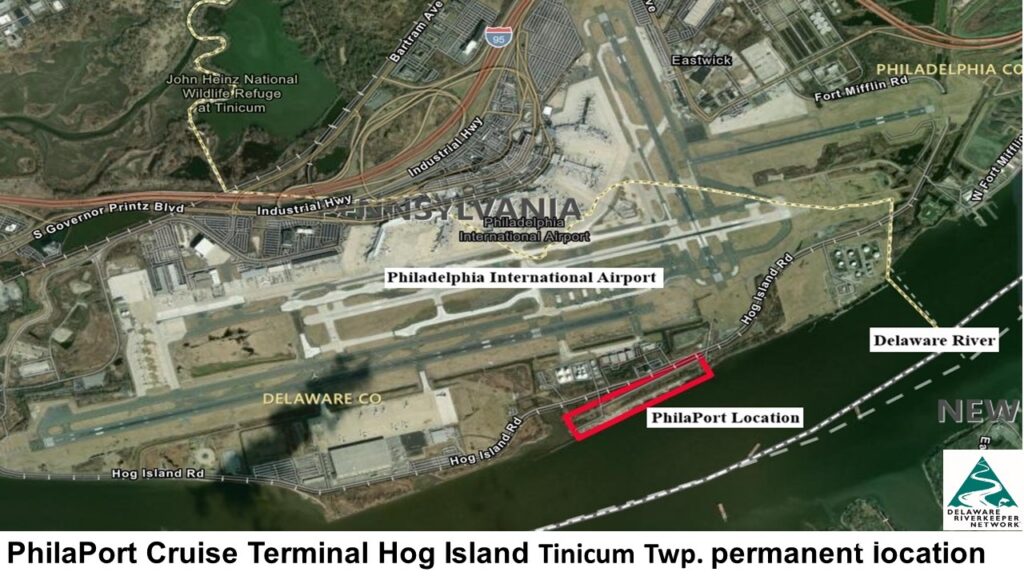
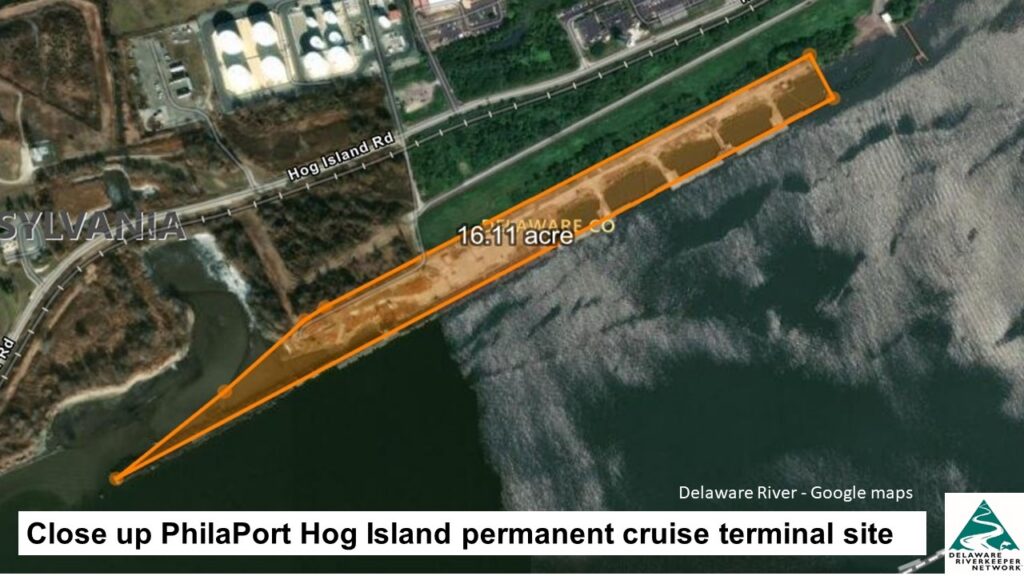
Norwegian Cruise Lines (NCL) quickly started selling tickets for a passage in April 2026 from the terminal, shown as being located on Hog Island, 4 Atlantic Ave., Philadelphia, 19153 – in Tinicum Township, Delaware County (NOT in Philadelphia!). According to the PPA website, “The ceremonial inaugural sailing will be April 16th, 2026, with the Norwegian Jewel.PPA also states that sailing will take place “April 16 through Oct. 17, 2026, featuring 24 calls to the city.”

From the NCL’s website: “Philadelphia International Airport is just minutes from the port, so you can go from runway to a getaway in no time. NCL offers 40+ voyages from Philadelphia to destinations like Bermuda, The Bahamas, the Caribbean, New England, and Canada…”

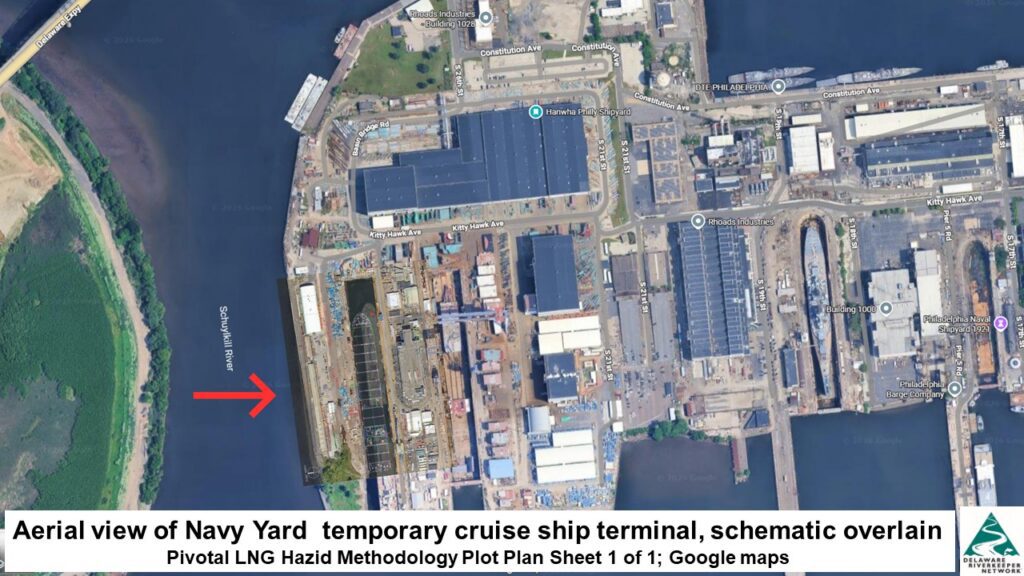
However, news reports have disclosed that the terminal is still under construction and won’t be ready for the April sailing. One cruise website revealed, “Messages shared in cruise community discussions indicate that sailings originally promoted as departing from PhilaPort’ s new riverfront terminal are instead being repositioned to a berth within the Philadelphia Navy Yard area for at least part of the inaugural season.”

24 cruises launched from a temporary makeshift site is a lot of activity – where are the reports and studies proving the Navy Yard temporary facilities and related operations will not have negative environmental and public safety and health impacts? What about communities in the region – how have they been informed and consulted?

The PPA website says that midsize ships carrying about 3,000 passengers will use the terminal. Cruising websites are promoting the industry’s reentry into the Delaware River Ports. The Norwegian Jewel carries 2,368 (double occupancy) passengers plus 1069 crew and has a draft of 28.3 feet. It is said that cruise shipping died out in 2009-2010 in Philadelphia “…due to factors like ship size constraints and logistical hurdles navigating the Delaware River.” It makes one wonder why the industry now thinks it will succeed.

Energy Transfer Marketing and Terminals is also listed as a partner in the public-private partnership with PPA and NCL. Why?

Questions

What are the public safety threats for Philadelphia and Southeastern PA from LNG fueling and cruise ship operations?

What are the potential environmental impacts for the Delaware River and its communities?

Where will they produce, transport and store LNG – a hazardous, flammable, and explosive material?

Will there be polluting air emissions?

How long will temporary terminal(s) be used and how many voyages are planned for the temporary location?

What are the permanent terminal location plans regarding LNG fuel and cruise ship operations?

Is there more than one temporary location for the cruise ship terminal?

Why haven’t communities been informed and consulted?

Please join our webinar on Thursday, April 30, at 7pm to learn more! Register here now.
LNG Export Proposal – Eddystone, PA

Welcome! SIGN UP HERE to engage in our campaign to prevent any LNG export facilities in the Delaware River Watershed!

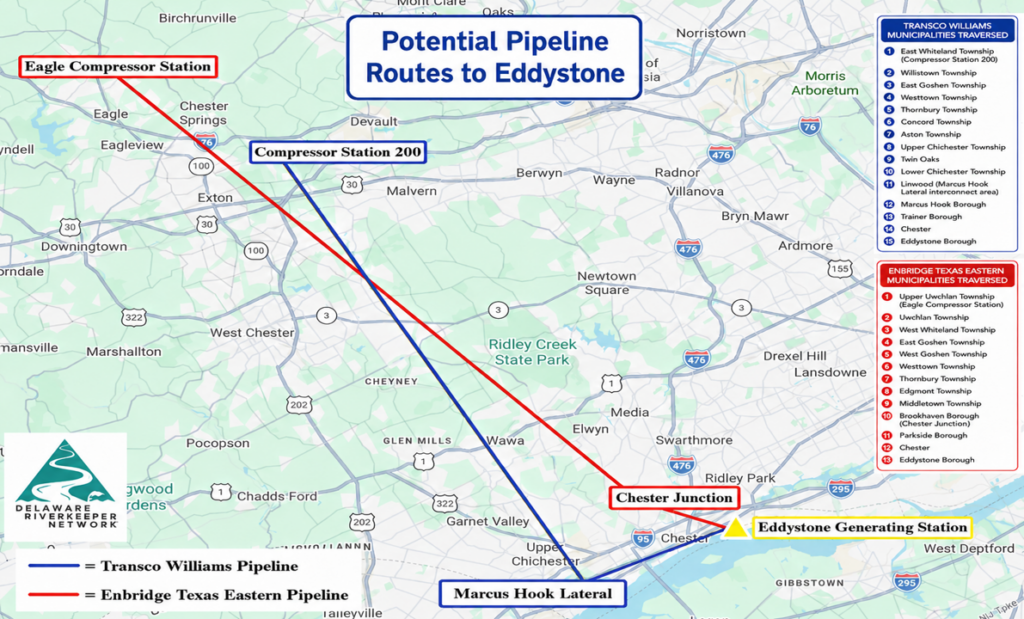
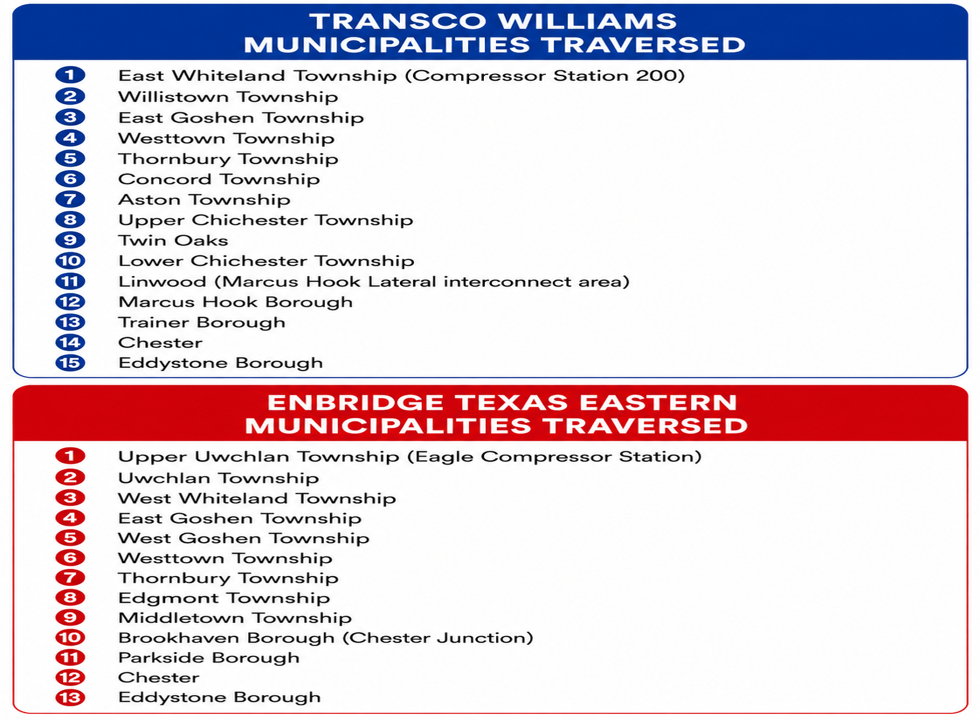
DRN learned through dozens of file requests (FOIAs, RTKL requests) with Pennsylvania agencies, federal agencies, and Governor Shapiro’s office some information about what LNG export facilities are being secretly planned and precisely where. We have learned that LNG interests and companies have met privately with officials in the PA Governor’s’ office, the Dept. of Community and Economic Development, local officials, and even with the White House, to push LNG projects in southeastern PA. (see: https://penncapital-star.com/energy-environment/as-trump-pushes-liquified-natural-gas-exports-some-in-pa-push-to-stop-a-proposed-lng-terminal/). But nothing has been revealed to the public about the proposal(s) even though the records DRN has received exposes that there is tremendous energy being invested by LNG export proponents to influence the agencies that would support their ventures. Despite all this secret activity, there are no permit applications as far as public records show. To read the files Delaware Riverkeeper Network has received through records requests, which verify these meetings and those who are participating, see Supporting Documents below.

We have unearthed valuable information but have also filed several appeals to try to obtain important records that were redacted or denied by agencies. The records we have received reveal intense lobbying with many participants behind closed doors. Also revealed is that the Dept. of Community and Economic Development and Eddystone Borough have separately entered into a Nondisclosure Agreement with a newly formed entity, Eddystone Energy LLC. It appears this tactic is to move the LNG project forward without public disclosure, seeming to abandon the Chester site and go to Eddystone instead. But the details are still unclear, and Delaware Riverkeeper Network continues to dig for information and share it publicly.

DRN is working with Chester Residents Concerned for Quality Living (CRQCL) to get this information out into the open, especially in the communities that would be most impacted We are holding forums and webinars. Go to NoLNGDelco.com to learn more about our teamwork to prevent LNG exports in southeastern PA.

We have learned through our investigative research that Eddystone Energy LLC is not registered as a corporation in Pennsylvania and has a registration in Delaware. EDDYSTONE ENERGY LLC is a Delaware Domestic Limited-Liability Company filed on May 12, 2025. The company’s filing status is listed as Active, and its File Number is 10191348. The Registered Agent on file for this company is Republic Registered Agent LLC and is located at 262 Chapman Rd Suite 240, Newark, DE 19702 https://www.bizapedia.com/de/eddystone-energy-llc.html. Republic Registered Agents LLC in Delaware (often referred to generically as a Registered Agent, Resident Agent, or Statutory Agent) serves as an authorized, physical, in-state point of contact for corporations and LLCs. They accept legal documents, lawsuit notices (service of process), and government correspondence on behalf of businesses. There are several other businesses in Delaware with the same address as Eddystone Energy because of this. Is Eddystone Energy LLC a “real” company? There is no address registered in PA, but there is an address in Belmont, MA under a registered agent Joseph Cleary, who refers to himself as an independent consultant and Renewable Energy Industry Executive on his LinkedIn page. The Massachusetts filing for Eddystone Energy LLC describes the business as “energy consulting.”

We will continue to share information as we receive it. Sign up here with DRN to become an e-activist opposed to LNG Exports.

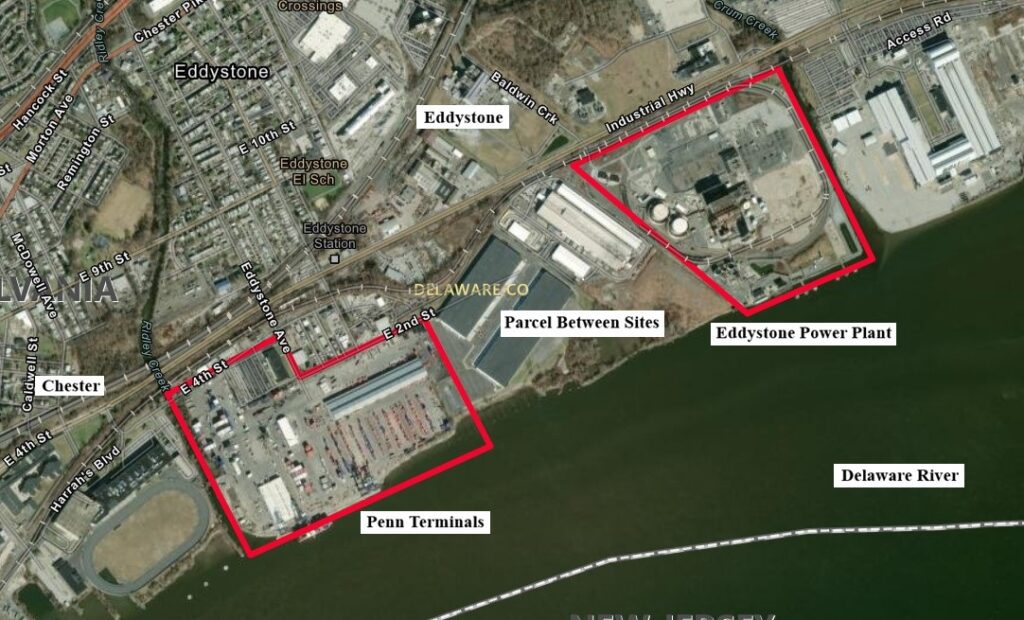
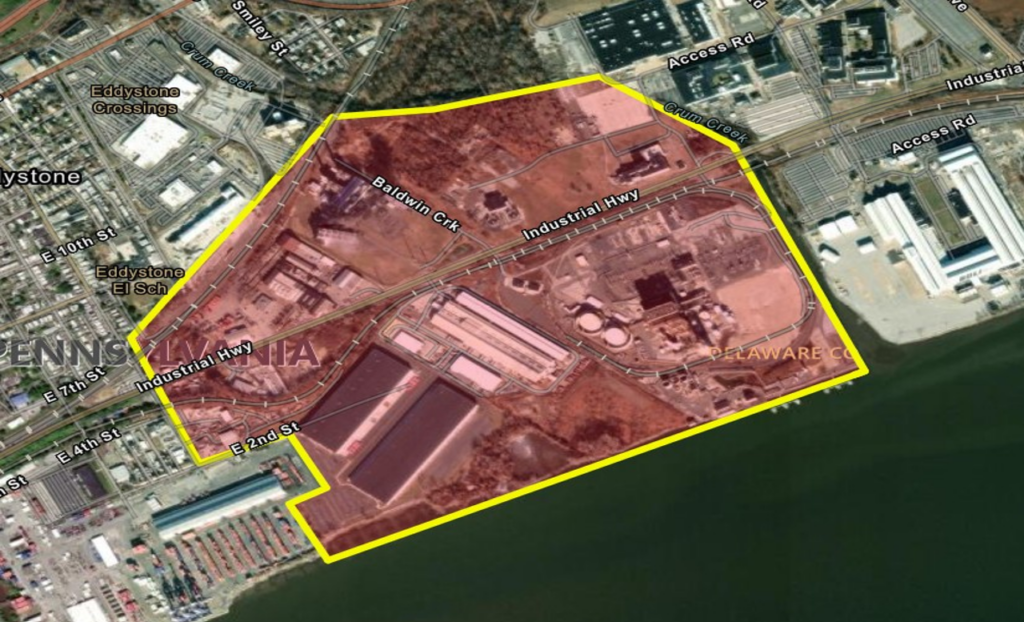
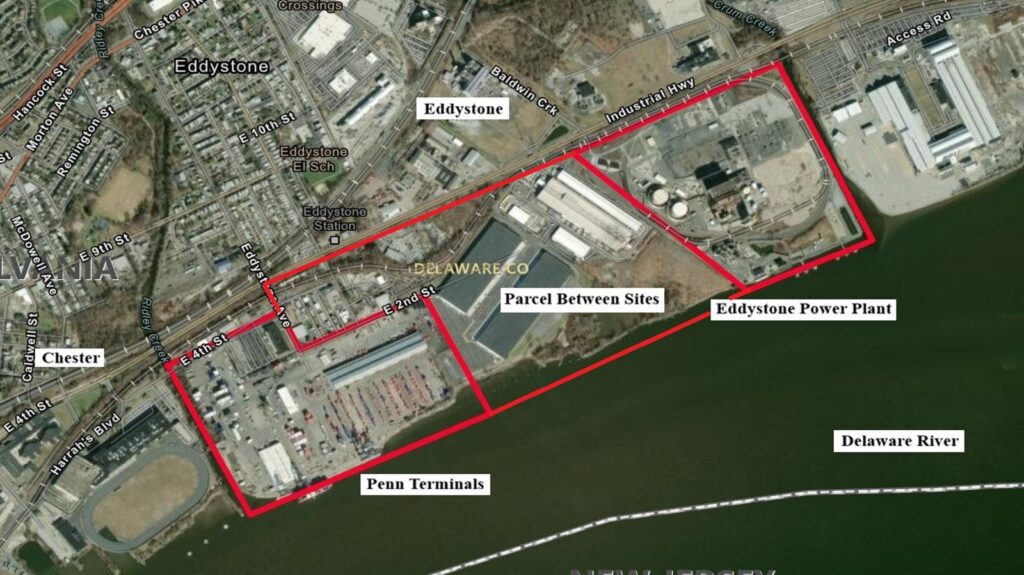
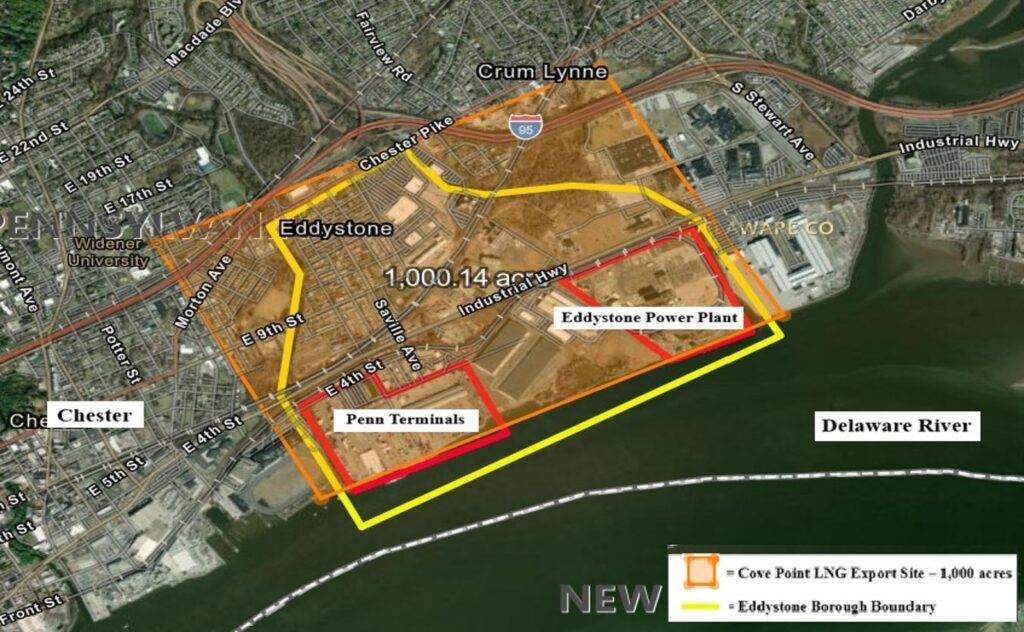
Map of Penn Terminals and Eddystone (Constellation) Power Plant properties in Eddystone Borough, possible LNG Export Facility locations under consideration by Eddystone Energy LLC
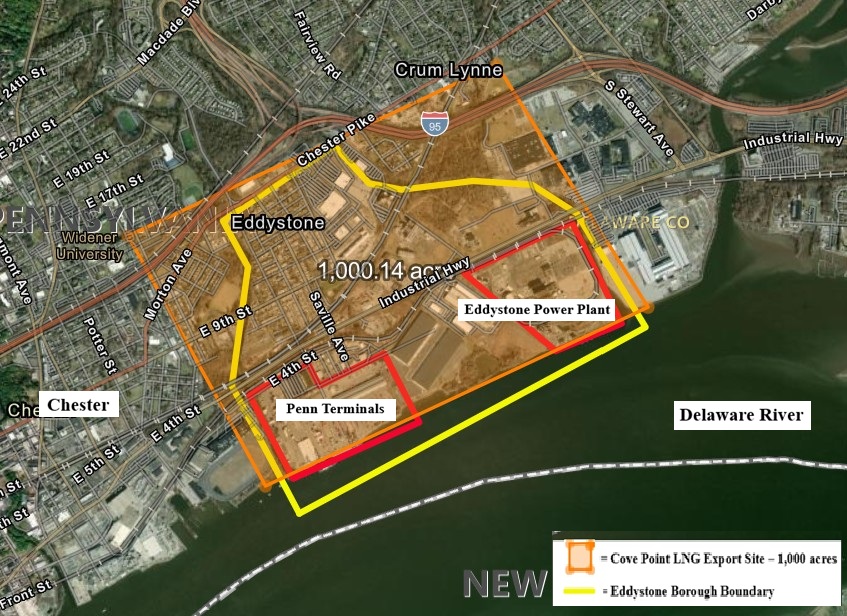
Map of the acreage of the Cove Point Maryland LNG Export Terminal site overlain on Eddystone Borough
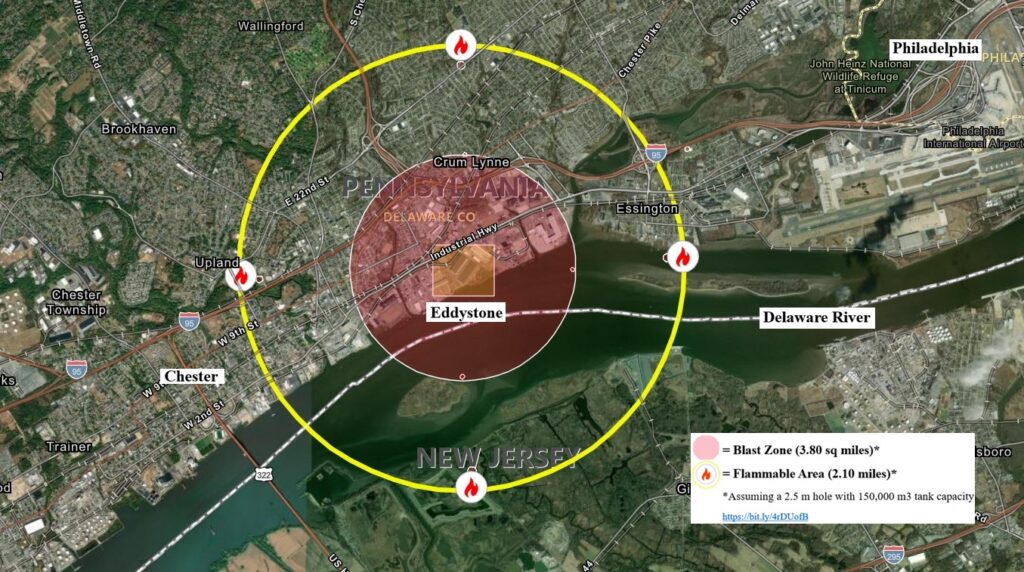
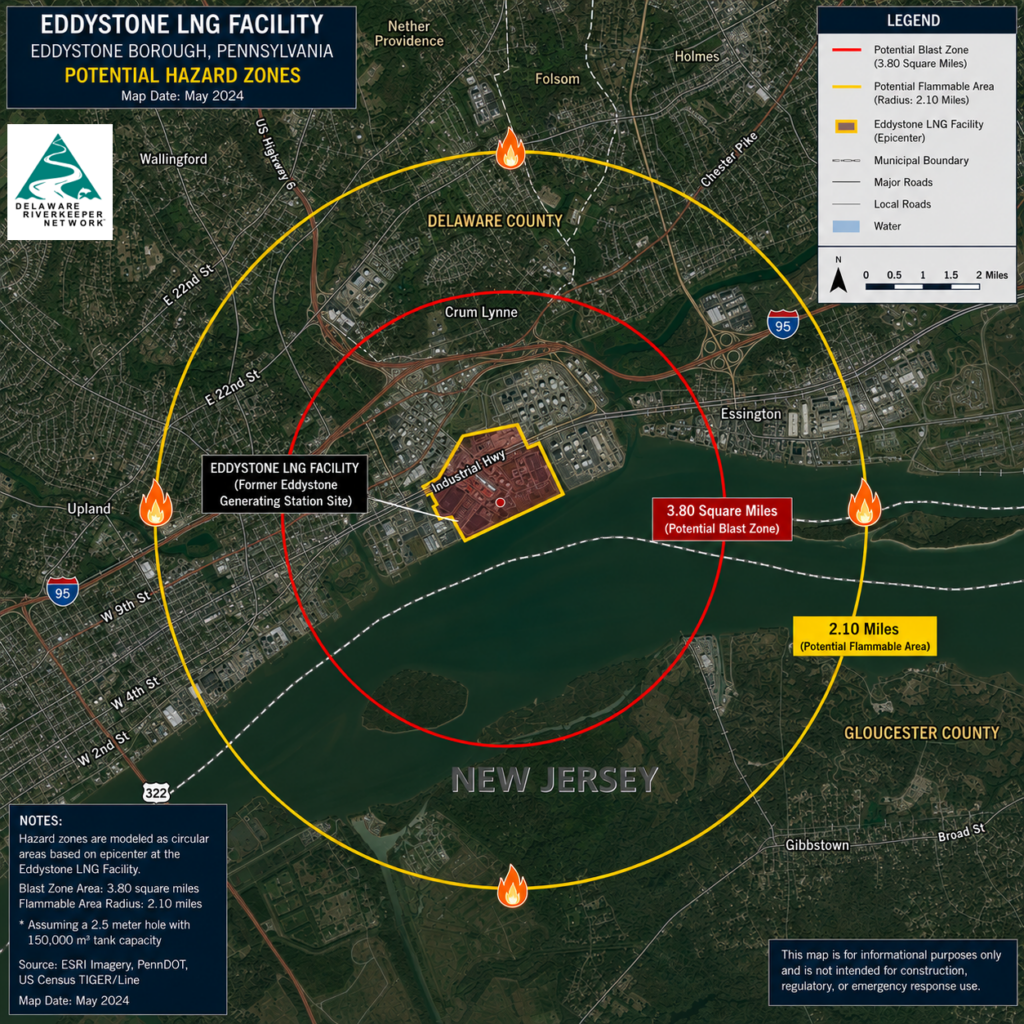
Estimated BLAST ZONE and Flammable Area with Eddystone LNG facility located on the Delaware riverfront in Eddystone Borough.

In addition to Eddystone, there are other LNG proposals in the Delaware River watershed. See Gibbstown, NJ, and Chester, PA for more information.

Data Centers

Overview

Data Centers are becoming an increasing concern. They bring with them a myriad of problems ranging from massive consumption of potable water, negative impacts on our nation’s climate goals, use of fossil fuels as an energy source, health concerns, placement in environmental justice communities, and a current lack of regulatory oversight of data centers while their growth continues at an unprecedented rate. Generating a 100 word email with ChatGPT would use an entire bottle of water for cooling down the servers. This water, currently, must be drinking water quality so as to not bring sediment, minerals, or other contaminants into the system that could disrupt the electronic components of the facility. The energy demands of data centers put the climate goals of the entire world in danger. The power demand for artificial intelligence (AI) alone is projected to triple by 2030 in the US.

Communities that live near a Data Center or multiple have reported issues with a consistent low humming noise coming from the facility. Others have experience constant light pollution, problems with drinking water to their homes, strange smells, negative health impacts, and even increased electrical bills. AI and data center use is so novel and new, that regulators, politicians, decisionmakers and the public are not yet aware of the harms that result from its use for the environment and the climate, and in turn for their own health and safety. But these projects are appearing at an unprecedented rate across the country and throughout the Delaware River Watershed.

Hydrogen and Hydrogen Blended Pipelines

Background

With the United States’ renewed interest in hydrogen as an energy carrier and the recent proposals for federally-funded hydrogen hubs, Delaware Riverkeeper Network has been closely monitoring hydrogen/hydrogen blended pipelines as part of our advocacy efforts.

Pure hydrogen gas (H2) is the smallest and most slippery of molecules, meaning it requires very specific infrastructure to prevent it from leaking and embrittling pipelines. As it stands today, there are only 1,600 miles of pure hydrogen pipelines in the United States (compared to 3 million miles of natural gas pipelines). This is troublesome for proponents of a national hydrogen network, who have aspirations of hydrogen being widely distributed to heat our homes, run our gas stoves, and generate electricity.

To mediate the lack of existing infrastructure for pure hydrogen transport, operators have turned to the idea of blending small amounts of hydrogen gas with natural gas, and transporting that mixture through our existing, extensive natural gas network.

Experts have cited a variety of concerns with hydrogen blending in pipelines, which has been untruthfully advertised as a stepping stone to decarbonization. From public safety issues, to economic concerns, to the entirely unestablished regulatory framework for overseeing hydrogen blends in pipelines, the bottom line is this: the rush to introduce hydrogen into our energy system in this way is not safe for our people or our planet.

Currently, Delaware Riverkeeper Network, as a leader in the Victory Over InFRACKstructure, Clean Energy inStead (VOICES) Coalition, has signed onto comments to the Pipeline and Hazardous Materials Safety Administration (PHMSA) asking them to forgo their information collection requests on hydrogen blending and just say no to hydrogen blending in pipelines. Should PHMSA still pursue hydrogen blending as an option, we have also signed onto comments demanding better safety, research, and information access measures before allowing hydrogen blending to occur.

Learn more about the problems with hydrogen/hydrogen blended pipelines with our resources below.

Carbon Capture, Sequestration, and Storage

Background

Carbon Capture and Sequestration/Storage is often shorted to the acronym (CCS). This can be confused with another acronym of a similar process, CCUS. CCUS stands for Carbon Capture, Utilization and Storage. Both of these refer to the process of capturing carbon dioxide (CO2), when it is created during a power generating or industrial process. This carbon is then contained and stored, sometimes underground or transported via pipeline, to prevent it being emitted into the atmosphere. The main difference with CCUS is rather than storing the CO2, it can be repurposed in an industrial process such as being used for fuel.

Carbon capture is being touted as a major climate crisis solution, but the evidence is to the contrary. CCS is expected to account for approximately 2.4% of carbon mitigation in the world by 2030.[1] Additionally, industry and legislators alike are saying that current CCS operations will capture 90-95% of the CO2 emitted. This is false. CCS facilities that have been studied have either completely shut down before full operation or fallen short of their goals and the global rate of carbon capture is only averaging about 83% currently.[2] Companies and facilities make bold claims when it comes to how much CO2 they plan to capture in their production. But when it comes to actual performance of the capture rate, expectations fall woefully short. The Illinois Industrial Carbon Capture and Storage project forecasted a 22% capture rate, but reported an actual capture rate of 12%.[3]

Enhanced Oil Recovery

Another issue with carbon capture is that it can also be used for Enhanced Oil Recovery (EOR), which is how the majority of captured carbon has been used to date.[12] This technique is where mature oil fields that are no longer productive through other methods, have the CO2 forcefully injected into the reservoir and force the oil up into the production well.[13] EOR is touted as a good climate solution because most of the time the CO2 injected into the ground stays there, as of now. But not always. A school had to be evacuated and relocated for several months in 2016 in Wyoming due to a CO2 leak from a nearby oil field where the company was using CO2 to force the oil out.[14] The odors of gas came from an abandoned well and it was reported that the levels of CO2 were 20 times higher than recommended.[15] The CO2 leaked through small underground cracks and rose up into the school.[16] This supports continued fossil fuel extraction at a time when we must be developing renewable energy that does not emit greenhouse gasses. Additionally, EOR allows for the dependence on fossil fuels to be perpetuated and continued the parade of false solutions.


[12] Commercial Carbon Dioxide Uses: Carbon Dioxide Enhanced Oil Recovery, National Energy Technology Laboratory, last accessed July 16, 2024, https://netl.doe.gov/research/coal/energy-systems/gasification/gasifipedia/eor, Section 9.2, Figure 1.

[13] Commercial Carbon Dioxide Uses: Carbon Dioxide Enhanced Oil Recovery, National Energy Technology Laboratory, last accessed July 15, 2024, https://netl.doe.gov/research/coal/energy-systems/gasification/gasifipedia/eor

[14] Cooper McKim, Wyoming School Shutter by Gas Leak Ready to Reopen, Inside Energy, May 26, 2017, https://insideenergy.org/2017/05/26/wyoming-school-shuttered-by-gas-leak-ready-to-reopen/#:~:text=Midwest%20School%20shut%20its%20doors,%2Dde%2DLis%20or%20FDL.

[15] Ibid.

[16] Ibid.

SEPTA Hydrogen Bus Project

Pilot/Test Project

The Southeastern Pennsylvania Transportation Authority’s (SEPTA) Hydrogen Bus Project is a pilot project that implements the use of 10 hydrogen fuel cell powered buses beginning in the fall of 2024. From April 2024 through to the fall of 2024, SEPTA states they will be “piloting” the hydrogen buses but it is unclear exactly what that means. SEPTA states that from the fall of 2024 on, the buses are expected to be put into operation in the city for a pilot or test period. During this same period, 10 New Flyer fully electric buses will also be tested. These buses will be operated on various routes around the city of Philadelphia for the next year. The testing period will culminate in approximately the fall of 2025, at which time it is expected that SEPTA will decide which technology to proceed with in the future to power its bus fleet (either hydrogen fuel cell or fully electric or both).

This is part of SEPTA’s larger strategic plan to have a zero-emissions bus fleet in place by 2045. The current bus fleet, powered by diesel fuel, will be phased out or converted to alternative power sources beginning in 2025. The 10 hydrogen fuel cell powered buses in the pilot program will operate out of the Midvale bus depot located at 2401 Roberts Ave. in Philadelphia. The hydrogen will be produced using electrolyzers and shipped approximately 800 miles via electric trucks from Tennessee in containers as a crypto-temp liquid. At the Midvale bus depot, the liquid hydrogen will be warmed to a compressed gas that feeds the fuel cells to power the bus. While in use, the hydrogen gas will be carried in canisters on the roofs of the buses.

Expanded Plans at Build Out

The pilot program is just the start of SEPTA’s hydrogen bus plans. A 2023 feasibility study outlined plans to convert SEPTA’s bus terminals into hydrogen storage and refueling stations to serve its hydrogen-powered bus fleet. The report claims that liquid hydrogen storage and fueling for their bus fleet is feasible at six of their eight bus depots. The hydrogen fueling scenario assumed for each site involves purchase by SEPTA of liquid hydrogen, to be delivered to each site by tanker truck. At each depot the liquid hydrogen would be transferred from the tanker truck to an on-site liquid storage tank(s) with capacity for 1 – 2 days of bus fueling.

Between four and ten tanker truck deliveries of liquid hydrogen would be required per week depending on the depot. The liquid hydrogen would be pumped from the storage tank(s), evaporated, and delivered to on-bus hydrogen tanks as a high-pressure gas via one or more hydrogen dispensers. SEPTA’s largest depot (Midvale) would require 45,000 gallons of liquid hydrogen storage (3 tanks). The estimated cost of installing the hydrogen storage and fueling infrastructure ranges from $6.5 million at the smallest depot to $16.1 million at the largest depot.

Why should I be concerned?

Hydrogen gas is highly flammable and burns with an almost invisible flame in addition to being colorless, odorless, and tasteless. The flammability and potentially explosive attributes of hydrogen makes it very dangerous to handle, transport, and store. The lack of  a visible flame, odor, or taste makes it very hazardous for workers and any residents in the vicinity because they would be unaware when a release has occurred.[1]

Hydrogen gas contains the smallest and lightest molecule, which increases the probability of leaks through small holes and materials. In other words, due to its low viscosity, hydrogen is much more prone to leak from infrastructure than other hydrocarbons. Hydrogen leaks approximately three times faster than natural gas and five times faster than propane on a volumetric basis.[2] Fires and explosions have occurred in various components of hydrogen systems as a result of leaks that can quickly meet a variety of ignition sources.

PA 401 Certification

Overview

February 7, 2017 the PADEP issued 401 Certification for the PennEast pipeline.  The Certification was formally noticed in the February 25, addition of the PA Bulletin.  February 28 the Delaware Riverkeeper Network submitted a Petition for Review to the US Court of Appeals for the Third Circuit.  (Appeal filed below).  

July 13, 2017 the Delaware Riverkeeper Network’s legal counsel argued in court that the third circuit should send the case back to the PA Environmental Hearing Board for review and identifying the myriad of ways that the oranization and its members had been denied critical rights as a result of the cart before the horse process the state, supported by PennEast, was utilizing.  To learn more about the arguments of the organization see the reply brief filed 8.7.17 below.

History of the Certification:

In a May 14, 2016 public notice PADEP announced its intent to issue a 401 Water Quality Certification pursuant to the Clean Water Act for the PennEast Pipeline Project.

A second request for comment was filed August 27, 2016, with a second 30 day comment period on what appears to be the identical filing of materials in May.

Key portions of the Application Submission and the public notice can be found in the resources below.

Additionally below you can find the comments and expert reports submitted by the Delaware Riverkeeper Network making the case to the state that they should deny the PennEast pipeline the Clean Water Act 401 Certification approval it is seeking.


FERC Certificate Challenge by DRN

Overview

January 24, 2018, the Delaware Riverkeeper Network filed a rehearing request challenging the FERC Certificate issued approving the PennEast Pipeline Project.  The FERC Certificate was issued at 8:20 pm on January 19, 2018.

A Rehearing Request must be submitted and denied before a legal challenge in court can be pursued.  FERC has 30 days to respond to the request.

Delaware Riverkeeper Network also submitted to FERC a Motion for Stay to halt construction and any other land disturbance pending the rehearing request. 

The Rehearing Request, Motion for Stay, and associated press release can be found below.

On February 22, 2018 FERC issued a tolling order in response to our rehearing request, placing our organization in legal limbo as it was neither a grant nor denial of our rehearing request. 

On March 15, 2018 the Delaware Riverkeeper Network submitted a rehearing request on the 2/22/2018 tolling order.  As expected, FERC issued a tolling order on this rehearing request on April 13, 2018.  Again, seeking to use this legal loophole strategy FERC has created to continue to prevent our access to the courts.  

On May 9, 2018, the Delaware Riverkeeper Network filed for a writ of mandamus seeking a court order that FERC respond affirmatively to our rehearing requests and also seeking to challenge the FERC final decision despite the tollling order.

All filings and documents can be found below.


Comments re Draft Environmental Impact Statement

Overview

On Friday, July 22, 2016, the Federal Energy Regulatory Commission (FERC) issued a Draft Environmental Impact Statement (DEIS) for the PennEast Pipeline project that is 1,174 pages long giving September 5 (then 12) as the deadline for comments.  FERC’s measly 45/52 day comment period was another blatant abuse of power by FERC in favor of the pipeline companies and to the detriment of the many people facing irreparable damage to their health, safety, environment and economic wellbeing.   Below is the cover comment and series of expert reports the Delaware Riverkeeper Network submitted in response.  

There are other attachments not included below but which can be provided upon request.


NYC Filtration Avoidance Determination (FAD) – Watershed Protection Program

Overview

New York City has one of the few unfiltered water supplies in the nation. That is how healthy our Delaware River water is – it is unfiltered and still clean and healthy to drink.  

Pursuant to state and federal law, surface water supplies must be filtered unless they can meet a strict set of standards that allow the avoidance of filtration. The Delaware River water that is served to New York City meets those strict standards. 

In July, 2017,  New York City’s Department of Environmental Protection (NYDEP) proposed the most recent version of the Filtration Avoidance Determination (FAD) program it needs approved in order to continue its ability to serve unfiltered drinking water to City residents and visitors. NYC’s Watershed Protection Program and FADs have ensured a nationally recognized effort that has protected not just New York City’s primary water supply but that has provided unrivaled protection to the water quality of the Delaware River’s headwater streams and preserved thousands of acres of critical watershed lands and riparian areas in the Catskills. It is important that this program continue on its current watershed protection trajectory and that it not be subverted for political or other purposes that would diminish the quality of the program and therefore the quality of the additional and ongoing protection given to the Delaware River and, in turn, all communities that live downstream.

The Delaware Riverkeeper Network has been active on reviewing and comment on the most recently proposed FAD, dated July 2017, because protecting the headwaters of the Delaware River for New York City also ensures the quality of the River is protected for all those who live and benefit from the Delaware River downstream.