
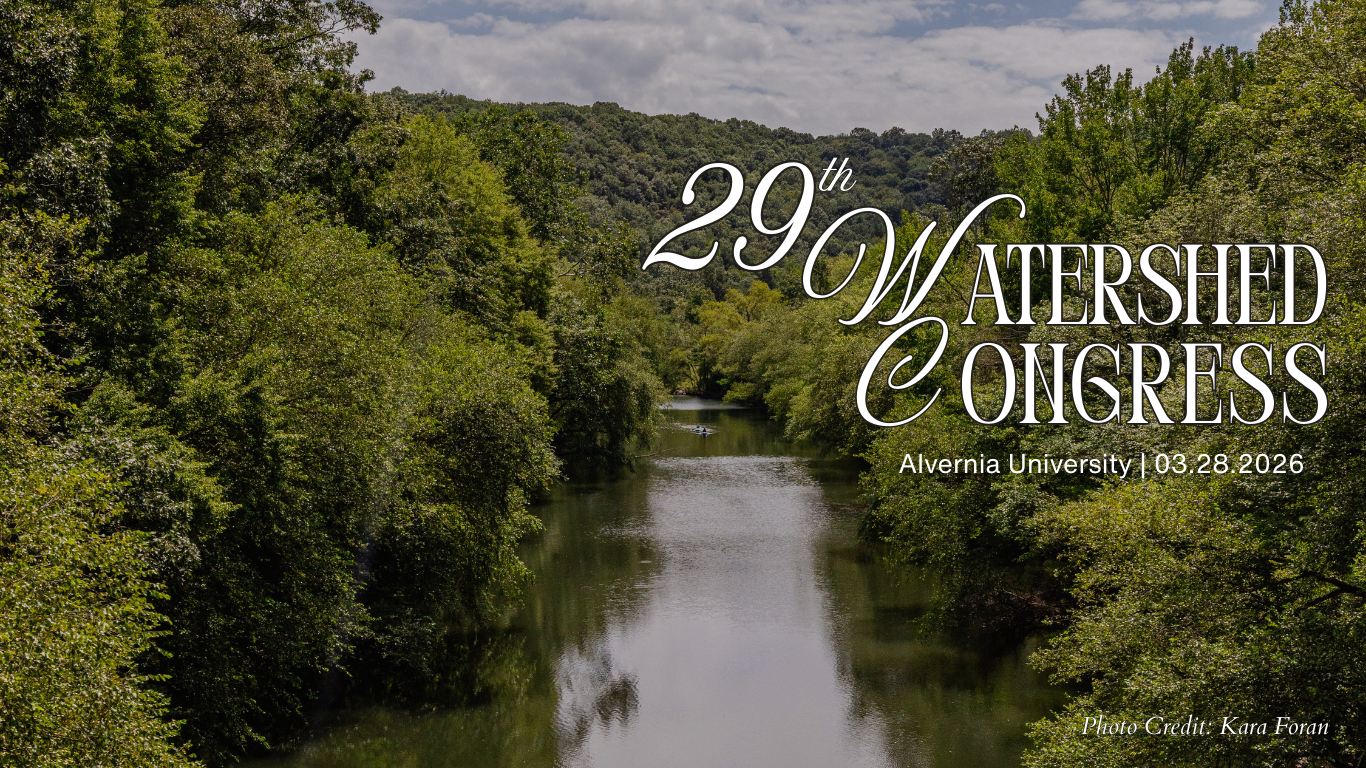
With a focus on networking across disciplines and a goal of presenting new information about watershed restoration, the annual Watershed Congress has become a highly anticipated event for anyone interested in understanding, protecting, and restoring their local streams.
Updates for 2026
The Watershed Congress returns to Alvernia University, located in Reading, PA.
Click on the links above for more information on each topic. Watch these pages for updates.
View the 2025 Watershed Congress videos HERE!
Alvernia University is not affiliated with the event and should not be contacted regarding the program.
The 2026 Watershed Congress is presented by the Delaware Riverkeeper Network and its partner organizations, as well as private individuals.
Current organization partners represent:
Alvernia University ⠂Berks County Conservation District ⠂Berks Nature ⠂Center in the Park/Senior Environment Corps ⠂City of Reading, Public Works ⠂Delaware Valley University ⠂Great Marsh Institute ⠂Green Amendments for the Generations ⠂Green Valleys Watershed Association ⠂Lundale Farm ⠂Meliora Designs ⠂Montgomery County Conservation District ⠂Montgomery County Community College ⠂Octoraro Native Plant Nursery ⠂Partnership for the Delaware Estuary ⠂Pennsylvania Department of Conservation & Natural Resources ⠂Pennsylvania Department of Education ⠂Princeton Hydro, LLC ⠂Schuylkill Action Network ⠂Schuylkill River Greenways NHA ⠂Stroud Water Research Center • Temple University • Valley Forge Trout Unlimited
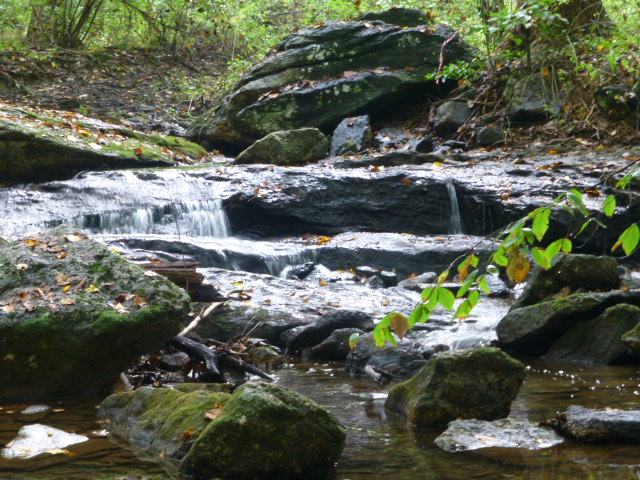
Topics for this years presentations include information on the Resilience Rooted in Place: Partnering with Communities to Address Flooding Through Nature-Based Solutions, and Why “With Community” Needs to be Foundational, Riparian Buffers, Urban Park & Habitat Creation Plan, Legacy of PA Coal: Mercury in Riparian Soils, Funding for Land Acquisition, Self-Directed & Low-Cost Storytelling through Videos, Greening Schuylkill County Schools, Native Plants in the Landscape, Mine Pool Mapping in the Schuylkill Headwaters, Dam Removal & Riparian Restoration, Society of Freshwater Science EPT Exam, Reading Wastewater Treatment Upgrades, and Promoting Safe Recreation.
Sponsors
The 2026 Watershed Congress is being made possible in part by grants from the the Pennsylvania Department of Conservation and Natural Resources through the Schuylkill River Greenways National Heritage Area, as well as by donations from our Exceptional Value, High Quality and Cold Water Sponsors and Friends of the Congress.
2026 Lead Sponsors
Exceptional Value
High Quality

Cold Water


Keynote
Resilience Rooted in Place: Partnering with Communities to Address Flooding Through Nature-Based Solutions, and Why “With Community” Needs to be Foundational
Abstract: Eastwick and Tinicum residents in southeast Pennsylvania have experienced increasing catastrophic and chronic flooding in the last decade. Additionally, climate change impacts will exacerbate future flooding and residents are disproportionately experiencing these climate change impacts in real time. As climate change exacerbates the effects of storms, flooding and erosion, the lives and livelihoods of these residents in the Lower Darby Creek Watershed will be at even greater risk. The goal of our project is to identify and evaluate nature-based strategies for flood risk reduction and ecological restoration that could complement ongoing project designs. Building on the previous planning efforts and in coordination with the US Fish and Wildlife Service, local government, community leadership, and property owners, the team is meaningfully engaging with stakeholders to identify, evaluate, and select habitat restoration strategies. Strategies focus on both short- and long-term actions that promote ecological and community resilience. Based on strategies identified and feedback, the team performed an Alternatives Analysis for the nature-based strategies. The analysis considered performance (flood risk reduction – both storm and sea level rise related – and ecological restoration potential), cost, constructability, public access and recreation opportunities, and operation and maintenance.

Christiana Pollack
Director of Restoration & Resilience, Princeton Hydro, LLC
Christiana Pollack, GISP, CFM, Senior Project Manager, Ecologist and Certified Floodplain Manager, is also a Certified Ecological Restoration Practitioner (CERP) through the Society for Ecological Restoration (SER. She has 15+ years of expertise in hydrologic modeling and ecological restoration, with a focus on freshwater and tidal habitats, living shorelines using natural and nature-based features, spatial analysis, and environmental mapping. She performs flood mitigation and wetland hydrology modeling in riverine systems, and, as a project manager, she oversees numerous ecological restoration design and geospatial projects, including vulnerability assessments and hazard mitigation planning mapping. Additionally, Christiana manages several wetland restoration projects that provide ecosystem services to mitigate flood risks, improve water quality, and strengthen storm resiliency.

Lamar Gore
Refuge Manager, John Heinz National Wildlife Refuge at Tinicum
Lamar Gore is the Refuge Manager at John Heinz National Wildlife Refuge at Tinicum in Pennsylvania since 2014, where the refuge team focuses on changing the face of how the U.S. Fish & Wildlife Service (Service) does conservation through “knowing” the community on a personal level. He works to continually view all his work in conservation with and through a community lens. He was raised in New Jersey, and as a child, had an affinity to explore and engage the outdoor world. His time with the Service began in 1991 on a multi-state work experience from Tennessee to Massachusetts, where biology was his only focus, but over the years as a biologist, regional biologist, and mid-level administrator, he began to understand a glaring problem in the conservation world, which was an inability to relate with the people we serve. This realization altered his conservation trajectory, which previously focused on restoring and managing habitat, and providing tools for biologists to accomplish their work. In 2014, he landed in Philadelphia, with the task of continuing the conservation mission through the lens of knowing and working with the community. His team works to identify community needs that align with Service priorities, creating community green space, as well as creating and deepening community connections with the outdoor world. One of his most important beliefs in his work is the introducing and engaging of the public from K-12, which builds a foundation for the future.

Kim Hachadoorian
Urban Conservation Project Manager, The Nature Conservancy
Kim Hachadoorian is an Urban Conservation Project Manager for The Nature Conservancy in Pennsylvania and Delaware, where she manages community-based watershed planning projects, to increase resiliency for people and nature. In Wilmington, Kim’s work has included coordinating volunteer activities and youth programs. In Philadelphia, she is working on projects to engage local communities and promote nature-based solutions to alleviate flooding and improve urban habitats. Kim holds a Master of Science in Environmental and Forest Biology from SUNY College of Environmental Science & Forestry, where she conducted research to assess the health of a forested watershed to protect New York City’s drinking water supply.
Schedule
| 7:30 am – 8:30 am | Registration Check-in |
| 8:30 am – 9:00 am | Welcome and Opening Comments Bernardine Hall (BH) Lecture Hall 014 |
| 9:00 am – 10:00 am | Keynote Bernardine Hall (BH) Lecture Hall 014 |
| 10:15 am – 11:15 am | Breakout Sessions 1 |
| 11:30 am – 12:30 pm | Breakout Sessions 2 |
| 12:30 pm – 1:45 pm | Lunch BH common Area / Krestrel Cafe Area Lunch and Learn with Nayantara Srinivasan and Mikhail Velez Poster Sessions |
| 2:00 pm – 3:00 pm | Breakout Sessions 3 |
| 3:10 pm – 3:30 pm | Closing Remarks |
Breakout Sessions
Breakout Sessions 1
A. Establishing Riparian Forest Buffers with Stroud Water Research Center
Heather Titanich and Calen Wylie, Stroud Water Research Center
Room: BH Lecture Hall 014
Abstract
The first half of the presentation will look through how Stroud Water Research Center designs, installs, and maintains riparian buffers. The second half of the presentation will look through Stroud’s methodology research in to forwarding riparian buffer success. The combined intent is to showcase how we do buffers and why we made those decisions.
B. Third River Urban Park & Habitat Creation Project
Ivy Rose, Princeton Hydro, LLC
Room: BH002
Abstract
In urban Bloomfield, New Jersey, a former brownfield situated within a 100-year floodplain was transformed into a public park featuring 4.2-acres of constructed wetland that is teeming with wildlife and a diverse array of native plant species. This project is an example of how green infrastructure can re-establish lost wetland ecosystem functions and values within an urbanized watershed through attenuating floodwaters, increasing flood storage periods, and providing attractive foraging and breeding opportunities for wildlife.
The project was successfully closed out in 2024; however, monitoring will continue indefinitely to gather long-term data of the constructed wetland’s functions and values. This presentation will illustrate the project’s history and provide post-closeout updates on the site’s current conditions.
C. Legacy of Pennsylvania Coal: Mercury in Schuylkill River Riparian Soils
Abe Doroshow, Alain Plante, Jon Hawkings, University of Pennsylvania
Room: BH005
Abstract
During the Schuylkill River Project of 1947-1951, engineers dredged large amounts of anthracite coal sediment from the river and deposited it in riverside impounding basins for reclamation as fuel. Legacy coal contamination is still visible in riparian soils that are frequently mapped as the Gibraltar soil series, characterized by “coal washings deposited over alluvium.” A series of soil profiles were sampled from Pennsylvania State Game Lands 234 in a transect away from the Schuylkill riverbank and analyzed for the toxic element mercury (Hg), a main environmental source of which is coal combustion. We measured total Hg, mobile Hg fraction, and percent coal. Hg concentrations in Gibraltar samples were elevated over uncontaminated samples, and Hg was correlated with increasing percent coal. However, the average Hg content of Gibraltar samples significantly exceeded the typical Hg content of Pennsylvania anthracite. These findings suggest that these coal-containing sediments may be a sink for retained Hg rather than its source.
D. Funding Realities: Adapting Land Acquisition Strategy to Local Context
Kyle Rose, Natural Lands
Room: BH001
Abstract
Land conservation projects often rely on external funding to acquire fee simple ownership or secure conservation easements. Yet the funding landscape is far from uniform. The viability of any given acquisition depends on a complex mix of factors: location, size, synergy with local and regional plans, the ownership type of neighboring parcels, the identity of the final landowner or easement holder, and whether public access is anticipated. In southeastern Pennsylvania, these challenges are compounded by uneven access to grant funding at the county and municipal levels. Some counties administer robust open space programs; others offer none. Municipal support varies just as widely.
This patchwork of funding availability creates significant disparities in which parcels can realistically be conserved – regardless of ecological value or community interest. This presentation will explore how practitioners navigate this fragmented funding terrain, offering examples of how local context shapes acquisition strategy. We’ll examine how partnerships and creative funding combinations can help close gaps in the “funding puzzle.” Attendees will leave with a clearer understanding of how to assess feasibility and adapt acquisition approaches to local funding realities.
E. Storytelling Through Self-Directed, Low-Cost Videos
Carol Carmon, Customer Relations Manager Consultant, with Shaelyn Parker and Fred Stine, Delaware Riverkeeper Network
Room: BH008
Abstract
Who is my audience and how in-depth and broad should my information be so the story is impactful, interesting and accessible? What are some considerations you should make beforehand so you get the footage for your desired video? Making short videos is an effective tool to post on your social media outreach and can help you document your event to influence decision-makers, recruit new volunteers and members, create social media content for your organization and your partners, and report to funders. Come hear tips and tricks from two experienced social media and educational content builders and, of course, bring your own stories to share.
Breakout Sessions 2
F. Greening Our Schools: Stormwater Solutions for the Schuylkill
Samantha Huxley, Rippled Waters Engineering, LLC with Marguerite DiGiorgio and Allison Hartman, Partnership for the Delaware Estuary
Room: BH Lecture Hall 014
Abstract
Rippled Waters Engineering partnered with the Schuylkill Action Network to create conceptual green infrastructure designs for four local schools in the Schuylkill Watershed. This project brings together science, education, and community to improve local waterways while inspiring the next generation of environmental stewards. Each school design focuses on solving real problems—such as flooding, erosion, and poor water quality—by using nature-based solutions that manage stormwater where it falls. Proposed features include rain gardens, biofiltration swales, and streambank restoration, which reduce erosion and filter stormwater runoff before it reaches nearby streams. Beyond their environmental benefits, these designs also create vibrant outdoor learning spaces for students. Native pollinator gardens, educational signs, and visible stormwater features help students see how green infrastructure works and why it matters. By transforming everyday schoolyards into living laboratories, the project connects students and community members to the health of the Schuylkill River and its watershed. These conceptual designs lay the groundwork for future projects that will make local schools greener, more resilient, and better connected to the natural environment around them.
G. Native Plants in the Landscape – A Trajectory of 35 Years
Jim MacKenzie, Octoraro Native Plant Nursery
Room: BH002
Abstract
We’ll discuss early adapters, current status, influences and future trends of native plants in the landscape including regulatory and non-regulatory factors. Topics will include high-level design, planning, application and maintenance practices. Focus will be on the mid-Atlantic region.
H. Mine Pool Mapping in the Upper Schuylkill Headwaters to Consolidate AMD for Treatment
Bobby Hughes, Eastern Pennsylvania Coalition for Abandoned Mine Reclamation
Room: BH005
Abstract
EPCAMR Executive Director will provide an overview presentation on mine pool mapping efforts in the Upper Schuylkill Headwaters concentrating on the Pine Knot, Oak Hill, and Repellier AMD discharges that are currently being monitored with the Schuylkill Conservation District and other partners to determine future AMD Treatment in the watershed. An overview of the mine pool mapping will be presented that will give the audience a closer look at the tedious and time consuming process of preparing surface and underground mine maps for further analysis to determine mine pool elevations, storage potential, whether or not the mine pools are flooded, and conservative estimates on remaining coal volumes and mine pool volumes underground based on the best available historic mine maps that can be found on the Mine Map Atlas.
I. Dam Removal and Riparian Restoration in the Valley Creek Watershed
Ray Clarke, Open Land Conservancy of Chester County
Room: BH001
Abstract
A small tributary to Valley Creek (EV) that flows through Open Land Conservancy’s George Lorimer Preserve had been dammed for prior farmland use. The smaller of two dams was eroding dangerously. The presentation will discuss solutions, removal of the dam, restoration of the stream channel and riparian habitat restoration. It will also cover a subsequent adjacent downstream project to remove invasive bush honeysuckle and plant with native trees, shrubs and perennials. The challenge going forward is how to deal with the much larger, sediment loaded, downstream dam. The presentation will discuss how a small all-volunteer land trust has approached this issue, and the importance of professional supplier and funding partnerships.
J. Introduction to the Society of Freshwater Science EPT Exam
Nicholas Macelko, Neshaminy Watershed Association
Room: BH008
Abstract
The presentation will be broken into three parts.
An explanation of what the SFS exam is, who administers it, and where an interested party can go to learn more.
The importance of the SFS exam, which is that two SFS certified individuals are needed for an organization to submit tier 3 data to the PA DEP.
A runthrough of taxonomic keys such as those found in “An Introduction to the Aquatic Insects of North America”. As well as an introduction to preserved or living examples of the mayflies, caddisflies, and stoneflies that may be found in those keys / inhabit the Delaware watershed.
Due to the recent invasions of insectivorous species such as Virile crayfish, Rusty crayfish, and Oriental weatherfish on the Delaware River it is important for our organizations to push individuals to document what conditions look like now before these species become established and change the invertebrate communities of our watershed.
Lunch and Learn
From Data to Dialogue: Creative Ways to Make Science Accessible
Nayantara Srinivasan and Mikhail Velez, Princeton Hydro, LLC
Room: BH005
Abstract
Have you ever struggled to communicate scientific findings to a disinterested audience? This interactive session will explore strategies to successfully engage the public and encourage participation through art, cartography, visual storytelling, and social media. Together, a Communications Expert and an Environmental Scientist will show how these techniques and tools can help translate complex data into something more accessible to general audiences. They’ll share lessons learned from past projects to help understand the dos and don’ts of science communication. Case studies will include volunteer initiatives along the Schuylkill River, community conversations about flooding in Trenton, NJ, and the use of an interactive StoryMap webpage to showcase watershed restoration efforts in Bucks County, PA. There will be recommendations on easy-to-access, free, and low-cost content creation tools.
Poster Sessions During Lunch
Hydrological Influences on the Flux and Phase Distribution of Trace Metals in the Schuylkill River
Zihan Geng, University of Pennsylvania
Abstract
Urban rivers often receive heavy metal inputs from road dust, building runoff, and atmospheric deposition. When rainfall or flooding changes the water flow, these trace metals can shift between dissolved and particulate forms, which affects their mobility and ecological risk. This project aims to study how hydrological conditions and seasonal changes influence the flux and phase distribution of trace metals, specifically Cd, Pb, Zn, Ni, Cu, and Cr, in the Schuylkill River of downtown Philadelphia. The goal is to understand whether rainfall events affect the transport of particulate metals and how this varies between wet and dry seasons.
River water was collected during both baseflow (dry) and stormflow (rainy) periods. Samples were filtered to separate dissolved and particulate phases. The particulate fraction underwent the first and last step of the BCR sequential extraction method to isolate the labile metals, and the total metal content, which was then analyzed using ICP-OES and ICP-MS. The concentration data were combined with flow rate records from USGS to calculate total metal loads. By comparing results between seasons and hydrological conditions, the study evaluates how rainfall, runoff, and sediment resuspension control metal transport in this specific urban location. The results will reveal clear seasonal and hydrological trends in labile metal behavior. These findings will provide insight into how climate-related changes in rainfall could alter metal pollution dynamics in urban rivers. Ultimately, this research will help improve understanding of contaminant transport under future hydrological extremes and support better water-quality management strategies.
Reversing Signals of Neglect: Legacy Pollution, Adaptive Governance, and Resilience in Historic Communities
Dr. Max Harleman, Villanova University
Abstract
A cross-disciplinary literature on just transitions shows that shifting to a lower-carbon economy can take jobs, tax revenues, and people from fossil-fuel-dependent communities. But few studies examine how pollution left by extractive industries may amplify and perpetuate losses. We conducted interviews with 39 stakeholders involved in remediating waterways polluted by abandoned coal mines in Pennsylvania, which once led coal production in the U.S. We find that water pollution acts as a “signal of neglect” that suppresses recreational use and economic activity and fosters pessimism among local residents. Communities with more social capital, defined by strong leadership and well-organized fishing and environmental networks, have successfully remediated numerous waterways. Although remediation and economic development initiatives were rarely coordinated intentionally, participants report that cleaned waterways support emerging tourism and outdoor recreation industries.
Complementing this, we study Pennsylvania coal communities over three decades, estimating how mine-impaired waterways—and their restoration—affect long-run population change. Communities with mine-impaired waterways and no restoration experienced 4 percentage points less population growth than similar nearby communities, while even partial restoration more than offset this effect, driven by college-educated individuals and those of college or retirement age. Mine water treatment systems by themselves had no effect apart from restoration status.
Together, these findings suggest that reversing signals of neglect can foster community optimism, support outdoor recreation economies, and enhance local resilience.
Scaling Watershed Education with the Schuylkill River Watershed Big Map
Ayashe Ramey, Schuylkill River Greenways
Abstract
An introduction to the best and biggest educational tool to experience the Schuylkill River right from your classroom—the Schuylkill River Watershed Big Map! This 30’x33’ vinyl map of the Schuylkill River Watershed allows teachers and students to step right into the lesson and get a bird’s eye view of the entire watershed. Students of all ages are able to use the map to learn how the entire watershed is connected, and ultimately be inspired to protect our waterways. Lessons on the map can explore any aspect of the Schuylkill River Watershed: history, water quality, geography, science, and more. This program is in its beginning stages, and Schuylkill River Greenways is currently piloting the Big Map with schools and summer camp groups. Participants will be able to test some of our Big Map programs first hand, and will explore how to maximize the impact of this giant resource moving forward.
Breakout Sessions 3
K. Consent Decree to Compliance: City of Reading Wastewater Treatment Upgrades
Bethany Ayers Fisher and Deborah Hoag, City of Reading, Public Works Department
BH Lecture Hall 014
Abstract
City of Reading was once a leader in wastewater treatment. Our story of how we got into a consent decree, back into compliance, and now improving the water quality in the Schuylkill River.
L. Olmsted Woods: 25 Years of Restoration and Research
Michele Adams, Meliora Design
Room: BH002
Abstract
Olmsted Woods, located on the grounds of the Washington National Cathedral, Washington, DC, has faced significant challenges due to drought, stormwater runoff, flooding, invasive species, and the broader impacts of climate change and urban development. Designed by renowned landscape architect Frederick Law Olmsted Jr., the plans completed in 1910 and 1924 emphasized the preservation of this five-acre woodland as a sanctuary for contemplation and reflection.
Olmsted Woods are cared for by the All Hallows Guild, which has undertaken extensive efforts to preserve and restore this vital natural space for many decades. In 1997, stormwater erosion gullies had cut ravines into the wooded hillsides, resulting in soil moisture changes and the decline and loss of many large trees. Deer browse had stripped the landscape. A comprehensive ten-year plan was developed and implemented, incorporating a range of green stormwater infiltration practices, forest restoration, and an invasives management plan to restore the forest.
In 2024, the Guild revisited the forest restoration work completed in 2002, inspecting and monitoring the stormwater infiltration practices, forest restoration, and gully stabilization techniques implemented two decades ago. This presentation will share the successes and challenges faced over 25 years of continuous work on this five-acre urban forest site.
M. Road Salt Intrusion Drives Changes in Wetland Plant Communities in Great Marsh, Pennsylvania
Benjamin Langey, Ducks Unlimited/Great Marsh Institute
Room: BH005
Abstract
Freshwater salinization, especially the use of road salts for deicing, poses significant threats to freshwater wetlands. The Great Marsh in Elverson, Pennsylvania, is a unique and valuable freshwater ecosystem, and the largest contiguous freshwater wetland complex within the highly developed Philadelphia suburban landscape. To investigate the effects of road salt intrusion on emergent wetland vegetation communities, I quantified sodium and chloride concentrations in shallow soils and groundwater and collected vegetation abundance data along transects extending into the Marsh from the Turnpike. I did not find a significant difference in mean deicing ion concentrations in either medium with increasing distance from the Turnpike; however, deicing concentrations were more variable in sampling points closest to the Turnpike. I found that species diversity indices decreased as a function of increased deicing concentrations in shallow soil, but not shallow groundwater. In my study area Phragmites australis was significantly more likely to be present in areas with high concentrations of deicing ions in shallow soil, but not shallow groundwater. Finally, P. australis presence and deicing ion concentrations in shallow soil and shallow groundwater were the only significant predictors when considering other physical and biological factors impacting vegetation diversity.
N. Research to Riverbanks: Collaboration for the Workforce of the Next Generation
Brent Erb, Nolde Forest Environmental Education Center, and Anna C. K. Erb, DSW, LCSW
Room: BH001
Abstract
Contemporary environmental challenges, including pollution, flooding, and climate change, pose significant threats to society, yet their impacts disproportionately affect marginalized individuals and communities. This interactive session is designed to explore global and regional examples of how environmental issues intersect with social and economic inequities, situating these themes within the local watershed. Building on lessons learned from recent research on collaboration among educators, school counselors, and partners, the discussion will explore strategies to expand awareness and access to environmental career pathways while advancing our common mission of community engagement and stewardship. We’ll conclude the session with a facilitated discussion and short interactive activity to identify concrete steps for improving outreach and collaboration to build upon our work in ways that are more inclusive. Participants will leave with practical strategies and resources to transform awareness into collective action.
O. Tools to Promote Safe Recreation and Information Sharing
Prem Trivedi and Alexander Wynne, Riverways Collaboration
Room: BH008
Abstract
Participation in on-water recreation in the region is estimated at 20,000–35,000 users annually and continues to grow. That’s like filling up a local sports stadium with paddlers! However, many communities on both sides of the Delaware River still lack safe and monitored access points near their neighborhoods and often use informal sites that have not been evaluated for safety. Riverways members have worked over the last 15 years to develop programs and access points, but the need remains significant. Riverways Collaboration was established in 2017 to ensure that organizations working in environmental education had the shared infrastructure and capacity needed to promote equitable recreational access to waterways in Philadelphia and Camden. As part of this effort, the consortium has developed a robust set of shared tools that guide program design and implementation, on-water safety, risk management, and evaluation. In this session, we will share information on our monitoring program, communication strategies, and data portal. These tools are helping us spread the word about paddling safety and access, since many residents in the tidal Delaware River (Trenton to the Delaware Bay) are unaware of the recreation programs and possibilities.
Watershed Congress Site:
Alvernia University
400 Saint Bernardine St
Reading, PA 19607
For Apple Map Users:
Bernardine Hall
916 Bornemann Rd
Reading, PA 19067
Alvernia University is not affiliated with the event and should not be contacted regarding the program.